Egyptonews
August-2008. Heliopolis, a huge temple and a massive statue both for king Ramsess II were discovered in Un city " modern Heliopolis" by an Egyptian delegation under the auspices of the supreme council of antiquities. Also a foundation for a cenotaph in side the same temple which reinforces the idea of following that tradition in early Egyptian temples as it was traditional with Tanis temples. The Egyptian delegation discovered a stone-head for god Khepri the scarab-god and a statute for the cat-goddess " Bastet" from EL Akhbar-newspaper.
Museuegypt comment.
"Un" also was the largest university and the oldest ever and it is believed that the title universe and university were driven from "Un". Un dates back to the pre-dynastic"6000-4000 B.C" Also Un was quite famous of its genius mathematicians who thought the whole universe the principles of the mathematics and the geometrics. Only I wish inform you that Pythagoras was one of its students" please read my article about the Rhind mathematical papyrus" Copyrig ©Musegypt
Friday, September 19, 2008


Egyptonews
Egyptonews
September-2008. Fayyum city. A vaulted burial chamber and a pink granite sarcophagus for king Senusert II were discovered inside his mud-brick pyramid in El lahun by an Egyptian delegation under the auspices of the supreme council of antiquities. Also a number of misleading corridors were discovered, in addition to some greaco-roman rock-cut tombs filled with skeletons in their rock-cut sarcophagi and a shelter for terracotta pots and jars. A huge sum of Egyptian pounds were dedicated for the future excavations by Hawaz , the chairman of the supreme council of antiquities. EL Akhbar-newspaper.Copyrig ©Musegypt
September-2008. Fayyum city. A vaulted burial chamber and a pink granite sarcophagus for king Senusert II were discovered inside his mud-brick pyramid in El lahun by an Egyptian delegation under the auspices of the supreme council of antiquities. Also a number of misleading corridors were discovered, in addition to some greaco-roman rock-cut tombs filled with skeletons in their rock-cut sarcophagi and a shelter for terracotta pots and jars. A huge sum of Egyptian pounds were dedicated for the future excavations by Hawaz , the chairman of the supreme council of antiquities. EL Akhbar-newspaper.Copyrig ©Musegypt
Friday, July 18, 2008
メーレルカ の 墓 は すばらしい もの ですね。
.JPG)
メーレルカ さん は おかさん゛チィティ さん と おくさん ゛ヘルワテトゲト゛ の あいだ に たっていました。
.JPG)
古代 イジプト の さんぎょう、 ゛金工゛きんこう と グラスせい の 物 が ある。
.JPG)
こだい イジプト の ぎょぎょう、ぎょせん と ぎょもうも ありました。こだい イジプト ぎょみん は にしん も しました。
メーレルカ の 墓 は すばらしい もの ですね。
メーレルカ の 墓、サッカラ に いち 番 有名 な 墓 です。メーレルカ の 墓 は 2400 紀元前 年 前 でしたね。メーレルカ は ティティ 王 様 の 大臣、むこ さん も でした。メーレルカ は 全体 に 書きやく や 神官 も でした。その 墓 は サッカラ の いち 番 大きい もの だ、へや が31いつ ある。メーレルカ の 墓、何時も、マスタバ とよう です。メーレルカ マスタバ の 中 に いろいろ な 場面 と リリフ の きが が あります。Copyrig ©Musegypt
Wednesday, July 09, 2008
Egyptonews
July-2008
Valley of the cemeteries, north of Abydos. The Egyptian supreme council of antiquities has announced a new discovery in Abydos by An archaeological delegation. A newly discovered sacred-Bird catacombs contained four jars for preserving mummified eagles found in a bet 1.5 meter in depth. In addition to a mass burial for seven mummified falcons and three mummies of eagles as well as some statues of Ushabties and some stone implements. Also they found some human burials that were related to the sacred-birds culture. Akhbar newspaper.Copyrig ©Musegypt
Valley of the cemeteries, north of Abydos. The Egyptian supreme council of antiquities has announced a new discovery in Abydos by An archaeological delegation. A newly discovered sacred-Bird catacombs contained four jars for preserving mummified eagles found in a bet 1.5 meter in depth. In addition to a mass burial for seven mummified falcons and three mummies of eagles as well as some statues of Ushabties and some stone implements. Also they found some human burials that were related to the sacred-birds culture. Akhbar newspaper.Copyrig ©Musegypt
Tuesday, June 17, 2008
Egyptonews
Egyptonews
June 2008-TWO NEWLY DISCOVERED CASTLES IN SINAI.
Two castles were discovered by the delegation of the Egyptian supreme council of Antiquities in Sinai. The first castle dates back to the 18th and the 19th dynasties. 1300 – 1200 B.C. The castle is located 30 kilometers to the east of the Suize canal and built out of limestone. The inscriptions on its walls contain the royal names of king Seti the first. The second castle was founded during the Persian dynasty
In Egypt. Both of the castles were used to secure the Egyptian eastern borders. Akhbar newspaper.Copyrig ©Musegypt
June 2008-TWO NEWLY DISCOVERED CASTLES IN SINAI.
Two castles were discovered by the delegation of the Egyptian supreme council of Antiquities in Sinai. The first castle dates back to the 18th and the 19th dynasties. 1300 – 1200 B.C. The castle is located 30 kilometers to the east of the Suize canal and built out of limestone. The inscriptions on its walls contain the royal names of king Seti the first. The second castle was founded during the Persian dynasty
In Egypt. Both of the castles were used to secure the Egyptian eastern borders. Akhbar newspaper.Copyrig ©Musegypt
Wednesday, May 28, 2008
EGYPTONEWS
EGYPTONEWS
May.2008. Abu Sir, Alexandria. A bronze statue for goddess Aphrodite, an alabaster head for queen Cleopatra vi, a Ptolemaic statue and a musk believed to be for Mark Anthony were discovered by the Supreme council of antiquities in Alexandria under the auspices of Zahi Hawas. Also they discovered some new subterranean trenches under the temple of Tabo-Zeos Magna. Akhbar newspaper. Copyrig ©Musegypt
May.2008. Abu Sir, Alexandria. A bronze statue for goddess Aphrodite, an alabaster head for queen Cleopatra vi, a Ptolemaic statue and a musk believed to be for Mark Anthony were discovered by the Supreme council of antiquities in Alexandria under the auspices of Zahi Hawas. Also they discovered some new subterranean trenches under the temple of Tabo-Zeos Magna. Akhbar newspaper. Copyrig ©Musegypt
Sunday, April 20, 2008
Egyptonews
Egyptonews
APRIEL-2008, Dahab, Tal el mashraba had been added to the Egyptian map of antiquities. The area of Tal el mashraba has lots of ruins that date back to varities of periods as it had been used for serving the northern harbor of Dahab. Some ruins were for storerooms and silos which were used by some of the Nabataens. The Nabataens had settled in Tal elmashraba starting from the first century B.C. The site had been excavated since 1989. El akhbar newspaper.Copyrig ©Musegypt
APRIEL-2008, Dahab, Tal el mashraba had been added to the Egyptian map of antiquities. The area of Tal el mashraba has lots of ruins that date back to varities of periods as it had been used for serving the northern harbor of Dahab. Some ruins were for storerooms and silos which were used by some of the Nabataens. The Nabataens had settled in Tal elmashraba starting from the first century B.C. The site had been excavated since 1989. El akhbar newspaper.Copyrig ©Musegypt
Saturday, March 29, 2008
EGYPTONEWS


March, 2008, The Egyptian supreme council of antiquities is searching for twenty royal –tomb in the Valley of the Kings.
The Egyptian supreme council of antiquities under the patronage of Zahi Hawas dedicated an Egyptian delegation to search for some royal tombs which exceed 20 tombs for queens and some tombs for kings. The Egyptian excavation will be searching for the tombs of Ramsess VIII and Thutmoses II in addition to twenty tombs of queens that date back to the 18th dynasty. Hawas mentioned that the recent Egyptian excavation in the Valley of the Kings had discovered an aushapti statue about 1200 B.C and some pottery in the tomb of king Seti I.Akhabar newspaper.Copyrig ©Musegypt
The Egyptian supreme council of antiquities under the patronage of Zahi Hawas dedicated an Egyptian delegation to search for some royal tombs which exceed 20 tombs for queens and some tombs for kings. The Egyptian excavation will be searching for the tombs of Ramsess VIII and Thutmoses II in addition to twenty tombs of queens that date back to the 18th dynasty. Hawas mentioned that the recent Egyptian excavation in the Valley of the Kings had discovered an aushapti statue about 1200 B.C and some pottery in the tomb of king Seti I.Akhabar newspaper.Copyrig ©Musegypt
Monday, March 10, 2008
EGYPTONEWS
 pHOTO BY KENNETH PINCHBECK
K.V5, the work had been resumed
February/March. The work has been resumed in K.V5 by the Egyptian/American excavation teams in order to reveal more secrets about this massive subterranean tomb. The massive tomb entitled K.V5 probably dates back to the 18th dynasty and seems that had been used by king Ramsess II, 1300 B.C for what exceeds sixty royal sons which makes K.V5 to be the largest discovered tomb for a family in the entire history. The tomb was discovered by the British excavator James Barton in 1824 then got lost a while until it had been re-found by Howard Carter in early 1900 then it disappeared one more time till the Egyptian/American excavation had discovered it in 1999. Copyrig ©Musegypt
February/March. The work has been resumed in K.V5 by the Egyptian/American excavation teams in order to reveal more secrets about this massive subterranean tomb. The massive tomb entitled K.V5 probably dates back to the 18th dynasty and seems that had been used by king Ramsess II, 1300 B.C for what exceeds sixty royal sons which makes K.V5 to be the largest discovered tomb for a family in the entire history. The tomb was discovered by the British excavator James Barton in 1824 then got lost a while until it had been re-found by Howard Carter in early 1900 then it disappeared one more time till the Egyptian/American excavation had discovered it in 1999. Copyrig ©Musegypt
Saturday, March 08, 2008
EGYPTONEWS
EGYPTONEWS
March, 2008. Some new tombs were discovered by the Spanish excavation of Madrid national museum in the ancient capital of Ahnasia, south of Egypt. The newly discovered tombs date back to the 1st intermediate period where Ahnasia "modern Bani suwiff" was the capital of the ninth and the tenth dynasties, 2191-2040 B.C. Most of the tombs were built out of mud-brick and limestone. This discovery throws the light on the 1st intermediate period which was a dark age described to be chaotic as Egypt had lost it's unification. Akhbar newspaper.Copyrig ©Musegypt
March, 2008. Some new tombs were discovered by the Spanish excavation of Madrid national museum in the ancient capital of Ahnasia, south of Egypt. The newly discovered tombs date back to the 1st intermediate period where Ahnasia "modern Bani suwiff" was the capital of the ninth and the tenth dynasties, 2191-2040 B.C. Most of the tombs were built out of mud-brick and limestone. This discovery throws the light on the 1st intermediate period which was a dark age described to be chaotic as Egypt had lost it's unification. Akhbar newspaper.Copyrig ©Musegypt
Wednesday, March 05, 2008
古代 イジプト 人 は 仲核 と 原子核 が 知っていましたか?

古代 イジプト 人 は 仲核 と 原子核 が 知っていましたか?
古代 イジプト の 信こう と 神話 も、アトム 神 は いち 番 物 だ 話ました。アトム 神様 は いち 番 古く そうぞうしゃ。彼 も いち 番 中核 でした。死者 の 聖書に 面白く 場面 が あって、その 場面 は うちゅう の 真中 に アトム 神様 が います。すして、アトム も こんらん の 真中 に およぐ だろう。それから、アトム は じぶん に いちばん ちゅうかく なりました。アトム 神 様 も 太陽 の いちばん 中核 でした。Copyrig ©Musegypt.
古代 イジプト の 信こう と 神話 も、アトム 神 は いち 番 物 だ 話ました。アトム 神様 は いち 番 古く そうぞうしゃ。彼 も いち 番 中核 でした。死者 の 聖書に 面白く 場面 が あって、その 場面 は うちゅう の 真中 に アトム 神様 が います。すして、アトム も こんらん の 真中 に およぐ だろう。それから、アトム は じぶん に いちばん ちゅうかく なりました。アトム 神 様 も 太陽 の いちばん 中核 でした。Copyrig ©Musegypt.
Wednesday, January 02, 2008
Saturday, December 08, 2007
The ancient inscriptions of Sohiel Island. B

The ancient inscriptions of Sohiel Island. B
On the island of Sohiel, south of Aswan city in Egypt, there are more than 250 inscriptions incised on rocks and boulders. Most of the Hieroglyphic inscriptions date back to the Middle-kingdom and the New-kingdom, 1800-1400 B.C.
The one is displayed here dates back the reign of king Tutmoses III, the 18th dynasty which about 1400 B.C. The inscription is incised on a granite rock and represents the royal scribe, high-priest and vizier Amunhotep while burning incense as an offering to cartouche of king Tutmoses III. Copyrig ©Musegypt.
Thursday, December 06, 2007
The true significance of Hathor in the Egyptian creed and myth. B

The true significance of Hathor in the Egyptian creed and myth. B
Hathor the mother goddess who protects the newly born child for seven successive days until he/she becomes healthy and safe. The myth of the seven protective Hathors is often repeated in almost every birth-chapel and always ends with the seventh-day party where gods all are invited then Hathor would present her rattle-toy to the child. Modern Egyptians had inherited many of these traditions as they still to celebrate the seventh-day birth party and invites all families and neighbors, then the seven grain-seeds should be scattered on floor of the child's house. Also the rattle-toy is presented to the children. Probably the division of the week to be just seven days world wide is after Hathor patronage. The most charming figure for Hathor is the one that represent her melting with a woman face her triangular face, elongated eyes and ears next to a woman cheeks, chin and mouth. . Copyrig ©Musegypt.
Saturday, December 01, 2007
The true significance of Hathor in the Egyptian creed and myth. A
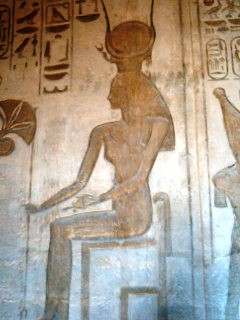
Goddess Hathor.Abu Simble Temple,1200 B.C.

King Narmer tablet" a cast carved by Yasser Kamel,black marble.
The true significance of Hathor in the Egyptian creed and myth. A
Hathor the cow-goddess is among the oldest gods in the Egyptian pantheon. Hathor also was one of the most popular goddesses there as she played the role of the holy mother and the wife for many of the ancient triads of deities. Hathor also was the perfect force that "Ra" had required in order to maintain balance between his flaming heat" skhmet" the urging power of the heat and the gentle force of appeasing "Hathor". Indeed the Egyptian myth describes both of the goddesses Hathor and Sekhmet to be the Yen and Yang. Goddess Hathor had to carry" Ra" the sun god out of the "Nun" the water as he sunk into it in order to appease its energy once he established the basic creation. Hathor the Egyptian Yen-force also had signified for the welfare, the prosperity, the wealth, the harmony and the unity. We can observe that powerful meaning in Predynastic and the archaic tablets that describe the unification trials in ancient Egypt and specifically the one belongs to king's Narmer 3200 B.C.
Starting from the Old-kingdom, 2878 B.C Hathor had become to represent the love, the joy and the maternity. Further on, Hathor was seen representing mainly the joy, the fun, the drunkenness and the fertility. The Bible and the Quraan brought us a very similar historical tale about an ancient Egyptian king and Joseph the prophet and it mentions the king in Egypt to suffer form a successive scary visions and he panicked then asked for counseling the dream-interpreters he had and none of them could help then they released Joseph from his prison and had been able to advise the king of Egypt. The king in his dream could see seven lean cows fierce and eat seven fat cows. According to Joseph's interpretation "Egypt should expect seven years of drought and dearth where the Nile would never flood" So the Hathors will be eaten and there will be no prosperity or welfare. Copyrig ©Musegypt. 2006
Saturday, November 03, 2007
ギリシャローマ博物館、愛 の 女神

ギリシャローマ博物館、愛 の 女神
アリキサンドリア の ゆめい な ギリシャローマ博物館 で いろいろ な いぶつ が てんじされました。
あそこに ビーナス の いち ばん きれい な ぞう が あります。そのぞう は だいりせき が つくられた。そのぞう は だいニ せいき あった、ビーナス と クピードを しめされています。古代ローマ 神話 に ビーナス 女神 と クピード 神 は 愛 の 神 でした。Copyrig ©Musegypt. 2006
Saturday, October 27, 2007
The ancient inscriptions of Sohiel Island. A

The ancient inscriptions of Sohiel Island. A
On the island of Sohiel, south of Aswan city in Egypt, there are more than 250 inscriptions incised on rocks and boulders. Most of the Hieroglyphic inscriptions date back to the Middle-kingdom and the New-kingdom, 1800-1400 B.C.
The one is displayed here dates back the reign of king Ramsess II, the 19th dynasty which about 1200-1300 B.C. The inscription is incised on a granite rock and represents king Ramsess II while presenting to his father-god, khnum and both of the goddesses Satet and Anket the Erap-wine jars. The text informs us about having one of the royal princes appointed in both of Kush and Nubia as a viceroy also it mentions the name Aye who was a royal scribe and wrote that text. . Copyrig ©Musegypt. 2006
Sunday, October 07, 2007
Ramsess The Great adds a lot more of glory to Luxor Temple.

Luxor temple facade and gate.

A carving represents the exterior of Luxor temple with its full facade and obelisks,1300 B.C

A huge bull for sacrifice led by the ancient Egyptians to Luxor temple.
Ramsess The Great adds a lot more of glory to Luxor Temple.
Luxor temple is one of the most charming and impressive temples in all over Egypt generally and in Luxor city specifically. Luxor Temple was founded by the great faithful pharaoh to Amun, king Amunhotep III or Amenophis III and it dates back to the 18th dynasty which is about 1400 B.C. King Amunhotep III established the whole interior of the temple including the holy of the holies, the vestibules ,the open-court and the inner pylon. The temple was dedicated mainly for god Amun-Ra's cult and for celebrating the Opet feasts "the marriage feast" of Amun-Ra. The feast was held and arranged by the clergies of both temples and the royal family. The ram-headed sphinxes avenue, three kilometers long, which is the one connects Luxor temple with the Grand Karnak temple used to be crowded with flag boles, priests and sacrifices. The temple of Luxor was completed and finished by king Ramsess II who created the exterior of the temple and carved on its first pylon his great victory over the Hittites and their allies, that fierce war which started ages ago had brought Egypt a lot more of honour and dignity. The battle of Qadish, in Syria had given Ramsess II the whole prestigious image he aimed at. Luxor Temple was provided with two giant obelisks , gigantic pair of seated statues of king Ramsess II and four of his free-standing statues in order to commemorate his great victory in Qadish and to dignify his father Amun in Luxor temple. Copyrig ©Musegypt. 2006
Saturday, September 08, 2007
The Magnificent approach to Abu Simble on board of Prince Abbas cruise-ship.
 Photo by Ali Zenhom The Magnificent approach to Abu Simble on board of Prince Abbas cruise-ship.
Subscribe to:
Posts (Atom)
Art in ancient Egypt ! My T.V talk today! I hope you find it enjoyable!💙💙💙
Art in ancient Egypt ! My T.V talk today! I hope you find it enjoyable!

-
 象形文字 で 蜂 の 名前 は ビイチイ でした。古代 イジプト の 神話 に 蜂 は 太陽 神 様 の とも ですくて、蜂 も 蓮 と 朝顔 を 匂う、蜂 は 象形文字 で ごい は 王 です。それから、蓮 の 匂うこと は うまれかわり が 印 を しました。古代 イジプト ...
 -
Art in ancient Egypt ! My T.V talk today! I hope you find it enjoyable!
-
 The Egyptian wooden-training sword of king Tutankhamun. The Egyptian fighting-sword of king Tutankhamun. Ancient Egypt had developed ...
