Thursday, February 17, 2011

The Egyptian Museum, Humor in ancient Egypt.


A wooden toy of dancing pigmies. The Egyptian Museum.

Egyptians are humorous and in fact they were lovers of fun and sarcasm since the beginning of history. The most well known goddess for joy and fun was Hathor who also was goddess of music to whom a lot of temples were dedicated. The second famous god in ancient Egypt was Bes the god of fun , joy and music who is originally was more African as he was represented as a pigmy god holding a harp. Some of the ancient papyri which date back to old kingdom around 2500 B.C describe the desire for the royal family to have African pigmies brought peacefully or else to Egypt where they be employed as clown and jesters. Actually some of those musicians and jesters were local dwarfs who became rich and well off. The Egyptian museum has an interesting collection of toys includes a wooden dancing pigmies toy operates by bulling the cords that are attached to the rotating discs where the pigmies are attached.

The dwarf Seneb and his family. Cairo Museum.

Another example found which is a carving from Hatshepsut temple represents the chief of Punt tribe and shows his wife with a deformed body followed by a inscription mocks at that situation.
The chief of the Punt tribe and his wife.

God Bes while Harping, Philae Temple
By Yasser Kamel to Museumegypt, All rights reserved. Copyrig ©Musegypt.

Monday, February 14, 2011

Egypt is the biggest museum

Egypt is the biggest museum

for humanity and its heritage as it keeps what can represent more than 50 percent of mankind history and monuments. By Yasser kamel for Museumegypt.

Saturday, February 12, 2011

Egypt welcomes travelers back


Dear Travelers, sorry for the temporary shutdown, Egypt was under necessary
maintenance, we're happy now to welcome you back in a much better Egypt. You’ll be impressed

Friday, February 11, 2011

Sunday, January 30, 2011


Museumegypt is wishing Egypt a much better future and thanks warmly the Egyptians for protecting the Egyptian Museum and deeply thanks the British youth for their symbolic protest around the British Museum.
Museumegypt

Friday, January 28, 2011

The Graffiti in the ancient Egyptian temples.


The Graffiti in the ancient Egyptian temples.

The desire of keeping the self memory revived was not limited to kings and queens of ancient Egypt but was found with the very ordinary people of that time. The hidden reason behind having a lot of graffiti in ancient Egyptian temples or elsewhere was due to believing that the “ Ren” which is the title in the Egyptian Hieroglyphics, once it is kept it can lead the soul of the dead to find and recognize the deceased. Therefore leaving someone’s name can secure his rebirth and according to the ancient Egyptian religion and book of the dead, the creation of Man by god Ra required preparing five elements to make a human created. The first was the “ Ghed” which is the body, the second was the “ Ba” which is the soul, the third was the “ Ren” which is the name , the fourth was the double “ Ka” and the fifth was the “Shuyet” which is the shadow. The only hope for poor people to secure their rebirth was to carve their names on temples walls or floors or to be mentioned by their nobleman or lord in his tomb which we should not blame them for. The ancient Egyptian royal families and their entourage were able to afford to protect and keep their five elements so they never encounter much of obstacles that can prevent their resurrection, almost all were able to afford the expenses of the mummification so their Ghed can last and were able build tombs with much of texts, hymns and carvings which can lead their Ba back to them, also were rich enough to leave offerings that their Ka can enjoy it and therefore it remains nearby. Even were able to design tombs and burial chambers that overlook the true north to allow their “ Shuyet” or shadow to remain on sun rise and on sun set and definitely their Ren was easily saved in cartouche frames or carved in stone that can survive.

Ancient Egyptian Graffiti writings on Philae temple, about 300 B.C.


Some of the ancient Egyptian kings were keen to keep and protect their ancestor’s tombs and monuments and some kings were interested to carve their own names on statues of their ancestors after saving it from thefts or after getting it restored. Their aim was to secure the ancestor’s Ren as well as their own one.


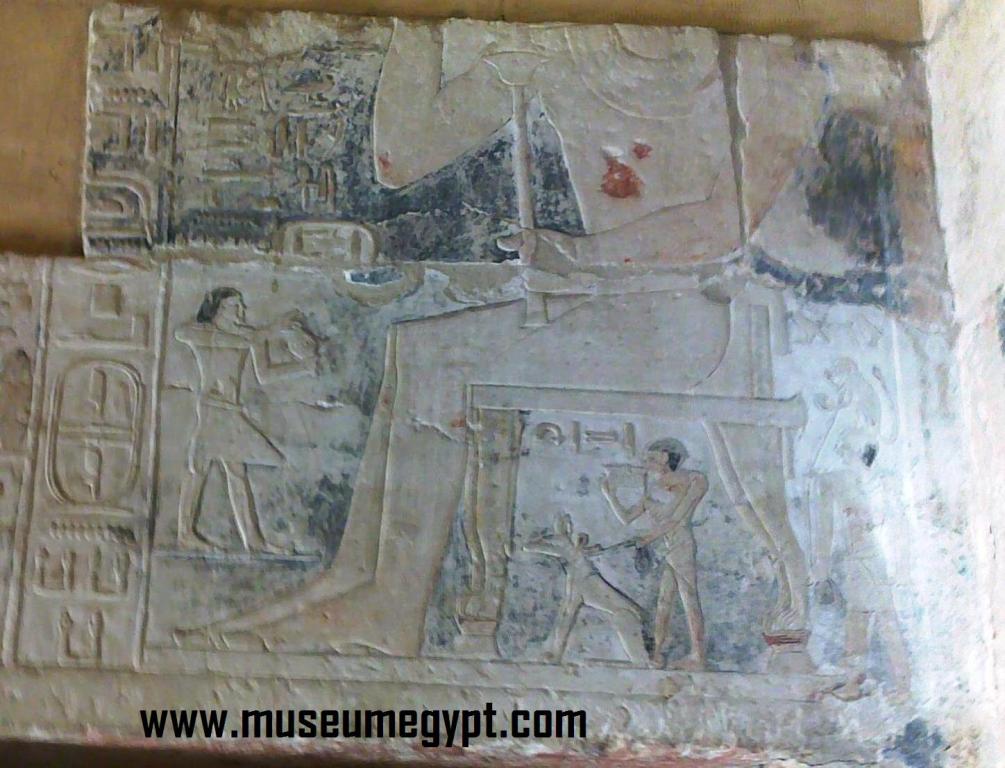
A carving “above” from tomb of prince Nekaw, son of king Essi,2500 B.C shows the servant who was entitled to look after Nekaw’s grey hound hunting dog , the servant “Ren” name is mentioned right above. As it was traditional for rich people to allow their popular servants to be described in their tombs by name and exact features to ascertain their rebirth as reward for their achievements.


A carving represents praises for Thutmoses II and Hatshepsut.

The carving above represents praises for both king Thutmoses II and Queen Hatshepsut meanwhile it shows the removal of her “Ren” and her praises from the inscription for being her reign counted by the ancient Egyptians an illegitimate.


Nubian finger graffiti on an ancient Egyptian monument.
The Nubian nomadic tribes had inherited the ancient Egyptian graffiti culture. The Nubian pilgrims in their pilgrimage to Egyptian temples used to dig the sandstone with their fingers in a trial to leave their finger-prints and to collect the sandstone dust to bring to their village.
By Yasser Kamel to Museumegypt, All rights reserved. Copyrig ©Musegypt.

Saturday, January 15, 2011

Museumegypt team of Egyptian tour guides


Museumegypt team of Egyptian tour guides is the most informative , each is qualified and has an Egyptology degree. To book a tour guide email. Yasserkamel@museumegypt.com.
Yasser Kamel
Senior Tour Guide

Saturday, January 08, 2011

カフラ の 座像


カフラ の 座像
カイロ博物館に カフラ の 有名 な 座像、その ざぞう は ギザに 発見された。その めいそく は たてあな の いん とく が あった、 あんぜん から でした。座像 は 大理石 が つくりた。その ものは 古王国 じだい のもの、だい 4王朝, 2500年 紀元前。座像 の あたま の うしろ に はやぶさしん は ホラス 守り神 です。
By Yasser Kamel to Museumegypt, All rights reserved. Copyrig ©Musegypt.

Hatshepsut and the trick of the Hotep positioning.


Hatshepsut and the trick of the Hotep positioning.


The Hotep-Shape Gardens in Der Elbahari temple.


Der Elbahari temple.

Queen Hatshepsut was one the most remarkable queens in the history of ancient Egypt as well as for the mankind history. Her unique personality and her natural intelligence next her outstanding determination were her most effective tools on her struggle for keeping the throne. She ruled between 1508–1458 BC and according to ancient historians as for she ruled in 1st Shemu “ summer season” on day4 and died in Year 22, 2nd Peret” winter season” on day 10 of her reign.
The sudden death of her brother-husband Thutmoses II was a serious shock for her as she became a very young widow and a mother for two daughters. Hatshepsut determined to become the ruling queen for Egypt however being a mother of two princesses and no male hair among, it seems that her plan of becoming the ruler of Egypt was much resisted by clergy of the Egyptian temples and also by some of her royal family members. In fact there was a wave of resentment on her decision to rule as a solo-ruler which inspired the opposition seeking an alternative successor for Thutmoses II and actually managed to reach Isis who was an unknown mistress for Thutmoses II . We just can imagine the shock which Hatshepsut had once that bad news reached her also the serious protection Isis was provided once she gave birth to a royal son. The queen’s opposition succeeded to claim his royal birth and announced him as Thutmoses III son of Thutmoses II and the legal successor for his father. Hatshepsut denied his royal birth right for rule as him was born of a mistress but her opposition were smart too as they forced the idea of allowing Thutmoses III to be married to one of her daughters to become appropriate for rule. Hatshepsut managed to become his princess-in-regent as well as a mother-in-law and a step-mother and according to many researches Thutmoses III was disdained by Hatshepsut and was allowed to share in the rule. The queen first trick was to portend that her refusal by her opposition is based on being her a female queen therefore Hatshepsut decided to be shown in all of her carvings as a man who is bearded and often dressed with a kilt even in her inscription on her temple the texts addressed her as a king .Her second trick was her claim of being herself divine in birth as born of her father god Amun the top of the gods pantheon which drifted her opposition attention to the event of being herself telling the truth or the vice versa. Her determination of getting a burial in the valley of the kings was so unusual but breaking royal and religious rules was impossible therefore her most powerful trick had to exist. The very early hieroglyphic character “ Hotep” which has several meanings such as verb to offer ,to calm ,to rest to relax ,to be happy and to be appeased or as nouns also it means offerings and an offering table. The same character was included by royal names of Middle kingdom kings as for the Montuhoteps as in name of king Montuhotep I who reunified Egypt and stopped its civil war therefore his name means Montu” god of war” is appeased. The most common use for the Hotep was to be the offering table for gods and kings once become deified in their tombs.


A stone table with the Hotep sign in the center. Alexandria national museum.

The Hotep sign resembles an inverted letter “T” in shape and it was inspired to king Muntohotep II to take as design for his temple where it contained his burial chamber and also pointed at his ancestors tombs direction. Doubtless that Senmut her architect and lover borrowed Muntohotep’s old design to provide Hatshepsut with a royal burial simply by building her a tomb at the back of her temple similarly with king Muntohotep II or by attempting to dig her tomb deeply in the cliff to be linked with the valley of the kings. Anyway her goal was reached as Her Temple at El der elbahary stood at a distance of only a few hundred meters in a straight line from the tomb that queen Hatshepsut had ordered to build for herself in the Valley of the Kings on the other side of the mountain. So her best trick to get an equal burial to male rulers was to adapt the Hotep positioning for her temple and tomb thereby she managed to get the equality she desired. It seems that her use for her father tomb Thutmoses I was unsuccessful and her admission to that tomb was prohibited but some final trick seemed to help her to cross with her body into the valley of the kings most probably after she sacrificed her identity where she was found. Her mummy was found in the tomb of her wet nurse, Sitre-Re, in kv60 as an unknown woman with no royal names or titles then latter was brought to Cairo Museum and left there for ages then just in the 2009 queen Hatshepsut identity was determined by the Egyptian Supreme council of Antiquities using the DNA test for the first time. In fact her mummy examination referred to her death to be normal in her middle age suffering Diabetes, arthritis.
By Yasser Kamel to Museumegypt, All rights reserved. Copyrig ©Musegypt.

Thursday, January 06, 2011

A Happy 2011 to all


Museumegypt wishes its followers and readers a very prosperous, wealthy and healthy year

Monday, September 13, 2010

King Tutankhamen was the son of Akhenaton! Was He?


A bust for Tutankhamen, Cairo Museum. Painted by the author.

Most of archaeological studies led us to one conclusion which is being
king Tutankhamen is the son of Akhenaton but none of it provided us with any hard evidence. The DNA and the Ct tests that were made for Tutankhamen in the Egyptian Museum Clinic in 2010, which were followed by the supreme council of Antiquities statement. That statement determined that Tutankhamen was Akhenaton’s son but did not
Specify the name or the title for the referee mummy or mummies where the DNA sample came from once they were testing king Tut mummy which makes it’s results to be doubtful. For many decades Tutankhamen was believed by some Egyptologists to be Amunhotep III son and that was due to some texts found carved in the Karnak temple which referred to him as a son for a king imagined to be Amunhotep III!. Maybe that conclusion was due to having no written or carved names found for Akhenaton in the Karnak temple as being him hated by its clergy.


Text refers to Ankhesamun”Akhenaton’s daughter” to be Tutankhamen’s sister, Translated by the author.

This may surprise the readers of this essay, a text refers to the fact that king Tutankhamen was Akhenaton’s son. Reads “ It is mentioned {to } the king {by} Nebet-hat {who} comes wailing
{on} for {her} brother the Osiried- King.” The text is incised on the back of Tutankhamen innermost shrine. The Hieroglyphics writing can be tricky as in this text the use of the word Nebet-hat has a straight meaning which is merely a name of the goddess Nephthys who was Osiris sister by birth ? but the hidden meaning was to refer to
herself as a sister for king Tutankhamen who is considered in the text to be Osiris and therefore Nephthys is to represent Tutankhamen’s sister and wife “Ankhesamun”.


From the left. Head for Nefertity , A slab has Akhenaton and his family. Copyrig ©Musegypt 。

Friday, August 20, 2010

Aswan tremendous Unfinished obelisk and a rare hieroglyphic text carved in the northern granite quarry. B

Aswan tremendous Unfinished obelisk and a
rare hieroglyphic text carved in the northern granite quarry. B


" King of Upper and Lower Egypt- {Men –Kheper-Ra}, child of Ra of his body, his beloved { Thut-moses III } master of offerings, he who is given the life as the Sun forever, made with love two great obelisks in the abode of Amun, in the Karnak.” Translated by the author from the Hieroglyphics”


The area in the northern quarry where Thutmoses III obelisk came from.


Thutmoses III “ 1300 B.C ,is the great owner for the text found, in fact he was one of the best builders for temples and obelisks among the pharaohs in general and just enough to mention his four famous obelisks which occupy for vital spots in four countries. His famous in London which known as Cleopatra’s needle, then
His unique one in New York as well as his one in Istanbul and his fourth one in Rome.

Copyrig ©Musegypt 。

Saturday, July 10, 2010

EGYPTONEWS

EGYPTONEWS

July-2010.Sakkara. Two ancient tombs found in Sakkara discovered by the Egyptian delegation which is in charge of Sakkara since 1986.The discovery was under the auspices of
the supreme council of antiquities. Dr. Hawas mentioned that the first tomb was for a father called Sen-Dewa while the other was for his son. Hawas explained that the main tomb has a unique false door with intact colours and it belongs to Sen-Dewa who was a senior royal scribe and a nobleman lived during the 6th dynasty around 2374 B.C. Also it has a twenty meter deep burial shaft with a wooden coffin in addition to five stone plates with duck forms that contained duck bones as well as a small stone obelisk. The other tomb was for Sen-Dewa’s son Khonsu who inherited the same job titles and it has a similar design. Both tombs are located west of the step pyramid. Akhbar Newspaper. Copyrig ©Musegypt 。

Monday, March 08, 2010

Looking for a private chinese teacher in Cairo


Call 0101670430 or 0123155284
EMAIL. yasserkamel222@hotmail.com
yasserkamel@museumegypt.com

Monday, February 01, 2010

Aswan tremendous Unfinished obelisk and a rare hieroglyphic text carved in the northern granite quarry. A


Aswan tremendous Unfinished obelisk and a
rare hieroglyphic text carved in the northern granite quarry. A


Always Aswan city was the main granite source for ancient Egyptians where they quarried the best quality of it. Due to this fact, 95 percent of the Egyptian obelisks came from Aswan quarries. Visitors of Aswan monuments always astonished of seeing such a gigantic obelisk in northern quarries. The obelisk rough estimation of it’s weight exceeds 1100 ton and it dates back to the new kingdom of ancient Egypt ”1400-1200 B.C” Egyptologists believe that cause for getting the obelisk left unfinished was having a flaw appeared in it’s monolithic body and led to obvious three cracks and due to that the work on it was abandoned. We only can imagine the amount of frustration the builders had felt once it happened especially it’s work was complete to 90 percent. It seems that the ancient labours had used cylindered wedges as well as pointy ones to cut the borders for the obelisk, the number of discovered wedges were often in sycamore. Knowing which wedge-log can fit for each stage of cutting the obelisk borders is so essential as the using
of the wrong sized –wedge may result a sever damage to the obelisk body. Either misjudging from the ancient architect on selecting the choice of the right sized-wedge in one main stage or choosing the wrong spot in the quarry to cut his obelisk from may lead to similar situation. Regardless to the hopeful researches on the ancient techniques that may ancient Egyptians followed in order to disengage the obelisk then to transfer and finally to erect no logic research is done yet.
We may happily accept the wedge method to disengage the obelisk from the granite quarry and tolerate the use of timber wood in order to case the obelisk body with which may help it to float once an enough strong flood be there.


But the matter is far more complicated than that as once someone to imagine the Nile flood with timber wood casing, done to the obelisk, would help the builders of the obelisk to float it just few meters out of it’s cut socket there be an actual challenge which is how to have a full control over a gigantic monolithic peace of granite that is bushed by a tsunami flood つなみ, 津波 in order to reach it’s destination which is supposedly the Karnak temple in Luxor which is about 150 mile north of the quarry. If luck helped the working team to reach with their obelisk the inside of the Karnak will be one final challenge to encounter which how to erect the obelisk over it’s pedestal ?! most of well known theories affirm the method for raising an obelisk should count on sliding technique which simply by creating mud slopes, ramps or embankments which could be in pairs
then having the obelisk sledged up the ramp then pulled down in between? In practice many thing turn to be so different such as for what quality of cords or ropes we should use that can hold the weight of the obelisk while it is pulled” keep in mind no metal chain or pulley were discovered from ancient Egypt yet”.


Also once to imagine the moment that the obelisk is to land in between of the ramps and the moment were it may swing or seesaw with such weight “ between 300 ton to 1200 ton” a splitting in its body and a catastrophe to result to the labours and to the surroundings of the crowded Karnak? Finally how to seek precision while following the previous method while keeping in mind that the obelisk bed is equipped with certain number of bibs or pegs that made mainly to nest on matching sockets on every obelisk pedestal. “Resumption for this essay will be soon” Copyrig ©Musegypt 。

Monday, January 11, 2010

古代 イジプト の こくそう と だいしょ です。


古代 イジプト の こくそう と だいしょ です。


古代 イジプト の 文化 は 2600紀元前 年 前 に  はんじ の 仕事 は ありました。古代 イジプト はんじ は たいてい 神官 も だいしょ いました。こ王国の 時代 に ひとや まだ ありませんでした。しかし、どろぼう に ばつ と おうだ 何時も ありました。メーレルカ の 墓 は 2300 年 紀元前 ぐらい、 その 墓 に 名場面 が あって、その リリーフ で ふぎり な だいしょ。その だいしょ の こくそう の てんけん の 時 は 空 に なりました。Copyrig ©Musegypt 

Saturday, January 09, 2010

EGYPTONEWS

EGYPTONEWS

January-2010. Alexandria city. A rare discovery for a statue that represents Alexander the great. The statue was discovered by an Egyptian-Greek excavation team in Hadaq El shalalat at the royal superb. The discovered statue dates back to 332 B.C. Also it is in very unique condition and counted to be the most complete statue for Alexander the great ever found.
Akhbar newspaper. Copyrig ©Musegypt 。

EGYPTONEWS

EGYPTONEWS


January-2010. Sakkara. Two ancient tombs were discovered the excavation team of the supreme council of antiquities in Raas El Gesur at Sakkara. Both tombs date back to 500 B.C and the 26th dynasty. The first tomb is counted among the largest in Sakkara and contained lots of ancient pottery and skeletons while the other tomb seemed to be looted during the Roman period. Akhbar newspaper. Copyrig ©Musegypt

Thursday, December 31, 2009

Picture and Comment


Could you send us some information on the Valley Of The Golden Mummies please we would be most grateful for any information you could give us. Dave & Irene Latch

The Valley of the Golden mummies.

This site is found in the Bahariya oasis which about 400 k.m south west of Giza. Valley of the golden mummies was an ancient Egyptian burial that dates back to different periods. The whole area was discovered by the Egyptian supreme council of antiquities and under the auspices of Dr. Zahi Hawas in 1996. The starting of the discovery was by mere accident as a donkey slipped into a tomb and led for the discovery of 250 mummies and roughly 45 tombs. The average age for discovered mummies is between 2000-2500 years. There is a rough estimation to number of mummies that may the future excavation bring to be 10,000 mummies. Also is believed that a lot of those mummies came from remote areas of Egyptian settlement, mainly during the Greco-Roman periods and that happened once the priests moved them to the desert. The reason beyond that was the taxation forced by the temple in order to store mummies and to maintain it and once space was lacked mummies were transferred secretly to the desert without letting somebody to know and to keep the tax continuously paid.


Yasser Kamel
www.museumegypt.com

Art in ancient Egypt ! My T.V talk today! I hope you find it enjoyable!💙💙💙

Art in ancient Egypt ! My T.V talk today! I hope you find it enjoyable!