Monday, February 01, 2010

Aswan tremendous Unfinished obelisk and a rare hieroglyphic text carved in the northern granite quarry. A


Aswan tremendous Unfinished obelisk and a
rare hieroglyphic text carved in the northern granite quarry. A


Always Aswan city was the main granite source for ancient Egyptians where they quarried the best quality of it. Due to this fact, 95 percent of the Egyptian obelisks came from Aswan quarries. Visitors of Aswan monuments always astonished of seeing such a gigantic obelisk in northern quarries. The obelisk rough estimation of it’s weight exceeds 1100 ton and it dates back to the new kingdom of ancient Egypt ”1400-1200 B.C” Egyptologists believe that cause for getting the obelisk left unfinished was having a flaw appeared in it’s monolithic body and led to obvious three cracks and due to that the work on it was abandoned. We only can imagine the amount of frustration the builders had felt once it happened especially it’s work was complete to 90 percent. It seems that the ancient labours had used cylindered wedges as well as pointy ones to cut the borders for the obelisk, the number of discovered wedges were often in sycamore. Knowing which wedge-log can fit for each stage of cutting the obelisk borders is so essential as the using
of the wrong sized –wedge may result a sever damage to the obelisk body. Either misjudging from the ancient architect on selecting the choice of the right sized-wedge in one main stage or choosing the wrong spot in the quarry to cut his obelisk from may lead to similar situation. Regardless to the hopeful researches on the ancient techniques that may ancient Egyptians followed in order to disengage the obelisk then to transfer and finally to erect no logic research is done yet.
We may happily accept the wedge method to disengage the obelisk from the granite quarry and tolerate the use of timber wood in order to case the obelisk body with which may help it to float once an enough strong flood be there.


But the matter is far more complicated than that as once someone to imagine the Nile flood with timber wood casing, done to the obelisk, would help the builders of the obelisk to float it just few meters out of it’s cut socket there be an actual challenge which is how to have a full control over a gigantic monolithic peace of granite that is bushed by a tsunami flood つなみ, 津波 in order to reach it’s destination which is supposedly the Karnak temple in Luxor which is about 150 mile north of the quarry. If luck helped the working team to reach with their obelisk the inside of the Karnak will be one final challenge to encounter which how to erect the obelisk over it’s pedestal ?! most of well known theories affirm the method for raising an obelisk should count on sliding technique which simply by creating mud slopes, ramps or embankments which could be in pairs
then having the obelisk sledged up the ramp then pulled down in between? In practice many thing turn to be so different such as for what quality of cords or ropes we should use that can hold the weight of the obelisk while it is pulled” keep in mind no metal chain or pulley were discovered from ancient Egypt yet”.


Also once to imagine the moment that the obelisk is to land in between of the ramps and the moment were it may swing or seesaw with such weight “ between 300 ton to 1200 ton” a splitting in its body and a catastrophe to result to the labours and to the surroundings of the crowded Karnak? Finally how to seek precision while following the previous method while keeping in mind that the obelisk bed is equipped with certain number of bibs or pegs that made mainly to nest on matching sockets on every obelisk pedestal. “Resumption for this essay will be soon” Copyrig ©Musegypt 。

Monday, January 11, 2010

古代 イジプト の こくそう と だいしょ です。


古代 イジプト の こくそう と だいしょ です。


古代 イジプト の 文化 は 2600紀元前 年 前 に  はんじ の 仕事 は ありました。古代 イジプト はんじ は たいてい 神官 も だいしょ いました。こ王国の 時代 に ひとや まだ ありませんでした。しかし、どろぼう に ばつ と おうだ 何時も ありました。メーレルカ の 墓 は 2300 年 紀元前 ぐらい、 その 墓 に 名場面 が あって、その リリーフ で ふぎり な だいしょ。その だいしょ の こくそう の てんけん の 時 は 空 に なりました。Copyrig ©Musegypt 

Saturday, January 09, 2010

EGYPTONEWS

EGYPTONEWS

January-2010. Alexandria city. A rare discovery for a statue that represents Alexander the great. The statue was discovered by an Egyptian-Greek excavation team in Hadaq El shalalat at the royal superb. The discovered statue dates back to 332 B.C. Also it is in very unique condition and counted to be the most complete statue for Alexander the great ever found.
Akhbar newspaper. Copyrig ©Musegypt 。

EGYPTONEWS

EGYPTONEWS


January-2010. Sakkara. Two ancient tombs were discovered the excavation team of the supreme council of antiquities in Raas El Gesur at Sakkara. Both tombs date back to 500 B.C and the 26th dynasty. The first tomb is counted among the largest in Sakkara and contained lots of ancient pottery and skeletons while the other tomb seemed to be looted during the Roman period. Akhbar newspaper. Copyrig ©Musegypt

Thursday, December 31, 2009

Picture and Comment


Could you send us some information on the Valley Of The Golden Mummies please we would be most grateful for any information you could give us. Dave & Irene Latch

The Valley of the Golden mummies.

This site is found in the Bahariya oasis which about 400 k.m south west of Giza. Valley of the golden mummies was an ancient Egyptian burial that dates back to different periods. The whole area was discovered by the Egyptian supreme council of antiquities and under the auspices of Dr. Zahi Hawas in 1996. The starting of the discovery was by mere accident as a donkey slipped into a tomb and led for the discovery of 250 mummies and roughly 45 tombs. The average age for discovered mummies is between 2000-2500 years. There is a rough estimation to number of mummies that may the future excavation bring to be 10,000 mummies. Also is believed that a lot of those mummies came from remote areas of Egyptian settlement, mainly during the Greco-Roman periods and that happened once the priests moved them to the desert. The reason beyond that was the taxation forced by the temple in order to store mummies and to maintain it and once space was lacked mummies were transferred secretly to the desert without letting somebody to know and to keep the tax continuously paid.


Yasser Kamel
www.museumegypt.com

Monday, December 28, 2009

HAPPY NEW YEAR.2010


Alexandria,Egypt,Montazah Royal Park and Palace.

MUSEUMEGYPT WISHES IT'S VISITORS A HAPPY NEW YEAR

Monday, September 14, 2009

The Egyptian History, Reference on the use of female warriors in battlefields.


The Egyptian History, Reference on the use of female warriors in battlefields.


Maybe it is not so common to imagine in the ancient battlefields that the female role would exceed the nursing service and its subcategories but the ancient Egyptian wars were familiar with some female fighters. History mentions queen Aiahhotep “alternatively spelled as Aahhotep” who had a great role in the Egyptian wars of liberation against the Hyksos, 1700 B.C and mainly after the death of her husband king Seqnenra while fighting his foes. According to her mummy examination she looked physically strong and muscular which referred to her physical participation in the actual battle. And due to her brave fight she was rewarded the golden flies’ necklace which used to sign for the unique valor for ancient Egyptian warriors. Another rich example that goes back to the reign of king Ramses II is found in Bait-Elwali temple, south of Aswan which is about 1200 B.C. A wall carving that represents king Ramses II wars in upper Nubba” southern Sudan “ where he is depicted in his triumph and receiving the spoils of war and a lot of Nubian handmade goods” such as incense, Myrrh , ivory, ebony, furniture, bows and so on”. Also it shows his sons while leading the army regiments and vanquishing their enemy. Surprisingly, a princess is shown while sharing an officer leading a chariot and the sign “ Heqa” which means ruler appears beside her. According to the text which is carved beneath she herself led a regiment,” Daughter of the king, from his body, his beloved Nu-Netri is going forth -while her lead- given power, the justified princess”.


Indeed observing the princess on her chariot was almost imposable as she is depicted with so masculine body and a single hair-lock similarly to any prince.


The inscription may emphasize her early death which could happened during the battle or just before making that carving as it was traditional to provide the title “Maa Khrew” or the justified to the deceased. Copyrig ©Musegypt. 2006

Thursday, September 10, 2009

The Journey into the Sun, the Solar Boats of Ra.


The Solar Boat of Cheops


The original rowlock.


The Journey into the Sun, the Solar Boats of Ra.

The most ancient dream for mankind was the everlasting and so was it for the ancient Egyptians. Since the beginning of the Egyptian ancient cultures the search for the eternity never had stopped, the worship of the Sun-God Ra had been the initiation for the settle. Ra was the main creator god and force that had vanquished the dark, the chaos and the time. His journey into eternity was represented by his death or disappearance and his rebirth by his rise from death. The Egyptian myths describe the king to the mortal reincarnation of Ra and in post mortem melts in the sun. The world heritage of antiquates was enriched in the year 1954 by the discovery of the first solar boat. The discovery of the solar boats at Giza was the most stunning event for the archaeological organizations mere luck helped to establish that discovery. The first Ark was discovered in a deep ditch to the south of the great pyramid of Cheops, the ditch contained a dismantled ship of cedar wood. The Egyptian archaeological team had faced a puzzle once they managed to extract it, the countless cedar fragments “around 1200 peace” that represent the whole ark. Surprisingly. The condition of the ship was as perfect as 95 % included its original ropes. The first assumption on the ship main function was suggested to be used for loading and transferring the royal funeral belongings, that thought was abandoned once the boat’s anatomy was examined by the experts. Meanwhile working on assembling the ancient ark by Ahmed yousif and his team four other ditches were discovered around the great pyramid. Two of the ditches were found loaded with similar cedar piles of fragments that represent two more ships while the other two ditches were found empty. Book of the dead describes Ra full journey to be completed by the use of great arks, so according to that reference the idea of the symbolism of the ship had projected. The first ship was restored and assembled in almost ten years the restorers they took advantage of the ancient hieratic signs that were incised by the original builders in order to reassemble it. The solar boat of Cheops is the most gigantic ship that the ancient world had created as it is 54.5 meters long and dates back to the fourth dynasty which is about 2500 B.C. Copyrig ©Musegypt. 2006

Tuesday, September 01, 2009

Esna Temple needs an urgent rescue!


Esna Temple needs an urgent rescue!

Esna temple is located few miles south of Luxor city, the temple is surrounded by the local houses and the village. Esna Temple foundations go back to the 18th dynasty of the Egyptian history which is about 1400 B.C. Its earliest excavations started by August Mariette in late 1800 as he managed to unearth most of the temple. Visitors to Esna are often stunned with its glamorous and vivid colours which exceeded 2000 years old. The temple has a rich inscriptions that record too many royal names for the kings who shared building the temple of Esna such as Thutmoses III , Ptolemy VI , Ptolemy VIII , Marcus Aurelius, Decius, Septimus Servus , Trajan and others. The temple is in very poor condition as it had been left surrounded by the village and its sewage as well as water table which caused obvious erosion to temple’s base and foundation. Also great part of Esna temple is still covered by the local houses. Museumegypt wishes to call the attention required from the Egyptian Supreme Council of Antiquities to be seriously and urgently concerned of saving Esna temple. Copyrig ©Musegypt. 2006

Picture & Comment


Carving from the chapel of Hathor in Komombo Temple, the 1st century B.C. It represents the Roman Emperor Trajan while offering the goddess Hathor a pair of Sistrums” rattles “.Copyrig ©Musegypt

Tuesday, August 25, 2009

Egyptonews

Egyptonews

Giza, The 23 0f August a national day. In a press conference on 3-08-2009, the day 23 0f August has been decided to be the city national day by the Giza state and under auspices of Professor Nour El Din” Professor of the ancient Egyptian language/Egyptology. Professor Nour El Din mentioned that the main reason behind choosing this day is that it is counted to be the exact date for the starting of the great pyramid construction which synchronized with the rise of the Sothic star at Giza in the year 2470 B.C. Copyrig ©Musegypt.

Wednesday, July 15, 2009

Museumegypt.THREE YEARS OLD


Museumegypt.THREE YEARS OLD
I hope that Museumegypt did meet expectation of it's visitors.
Yasser Kamel

Monday, July 06, 2009

Musemegypt, a wave of grief for a racial crime in Germany committed against an Egyptian-Muslim woman


Musemegypt, a wave of grief for a racial crime in Germany committed against an Egyptian-Muslim woman.

A German racialist had attacked 32-year old pregnant Egyptian-Muslim woman while his trial in a German court “Dresden”. Days before she was beaten by that male German racialist in a public park where he insulted her referring to her head scarf and offending her religion. On the day of the trial and after been accused for having abused her, suddenly he stabbed her 18 times till death and injured her husband too. The great disappointment comes from the German police officers who stood still the whole time and even someone shot her husband by mistake. The German police officers had an unexpected situation against the murdered woman as they searched her house for any evidence would make her a suspect. The murderer and his extreme hates to Islam represent a bad image for Germany where freedom and democracy is claimed. By Yasser Kamel

Wednesday, July 01, 2009

EGYPTONEWS

July-09. The first museum for the Egyptian crocodile. A new museum attached to Komombo temple, south of Aswan with a cost of 10000000 Le dedicated to collection of the ancient mummified crocodiles which represented god Sobak the crocodile god . The new museum will be opened shortly mentioned by the supreme council of antiquities. Copyrig ©Musegypt 。

EGYPTONEWS

EGYPTONEWS

June-09. The 18th dynasty mummies examined in the 2nd DNA lab. The supreme council of antiquities authorized the transfer of the 18th dynasty mummies to the 2nd DNA lab at the Qaser Elaini hospital for a DNA examination. Copyrig ©Musegypt 。

Wednesday, June 03, 2009

 みおも な ハイエナ の話


みおも な ハイエナ の話


古代 イジプト の 歴史 に いろいろ な 動物 の 話 が あります。みおも な ハイエナ の 話 は 本当 に おこりました。古代 イジプト の 古王国 の 時代、2400 年 紀元前 前 に 有名 な 動物 の 物がたり、たとえば、メーレルカ の 墓 です。メーレルカ の 墓 は 2300 年 紀元前 ぐらい、 その 墓 に 名場面 が あって、その リリーフ で ハイエナ の しゅっさん が みせいる。ばめん も ハイエエナ は じゅうい さん は かんかい を 上げます。じゅうい さん も ハイエナ に いろいろ な 食べ物 を 上げました。ハイエナ は 象形文字 で ヘセト でした。
Copyrig ©Musegypt                                   

Saturday, May 09, 2009

カイロ 博物館 に いち 番 古く かま と くわ が あります。

古代 イジプト、 先王国 時代、3500 紀元前 木製 かま。

カイロ 博物館 に いち 番 古く かま と くわ が あります。
古代 イジプト の 先王国 時代 で のうえん が わかられた。古代 イジプト のうみん は いろいろ な かま と くわ を 造りました。かま と くわ 何時も 木製物 でした。

Monday, March 30, 2009

A HAPPY EASTER


A HAPPY EASTER WISH FROM MUSEUMEGYPT
picture of the Great sphinex and the pyramid of king Chepheren. Don't you wish to be here?

Sunday, March 22, 2009

Luxor, West Bank is rich with its geology too!


Luxor, West Bank is rich with its geology too!


Luxor city, Egypt is renowned of keeping one -third of antiquities of mankind. Also Luxor is rich with its geological finds of fossilized sea shells and petrified trees. A petrified tree, from Luxor's nature. . Copyrig ©Musegypt 。

Wednesday, March 18, 2009

Pre-Historic Palette-Naqada III culture. "Special articles"


Pre-Historic Palette-Naqada III culture. "Special articles"

It can be a unique experience for those who are fortunate for being familiar with Egypt Pre-Historic cultures" 6000-3000 B.C", and once they become able to observe it a lot more detailed. The collections of Pre-Historic cultures that are kept in the Egyptian Museum, the British Museum, the Louvre Museum and the others which include very informative and descriptive palettes and tablets refer much to that deeply antique époque. A lot of these tablets were commemoratives and created in record of a victory after a civil war or after a war with other nations such as the commemorative mace cover that describes the unification trial of the Scorpion king "4000 B.C" or the Libyan tablet which depicts an Egyptian defeat to the Tehno Libyan tribes. The pre-historic slate tablet represents the unstable status of Egypt during Naqada III "4000 B.C" and a civil war that was between Naqada culture or Upper-Egypt and northerners of Lower-Egypt. The upper part of the tablet represents captives are bound in poles with stylized arms that grasp each of the captives and in a shape of a war adze. Also we observe carrion-birds that stand still on each pole which emphasize a traditional technique of torture or punishment and that what could have inspired the ancients with the first crucifixion. Also we see the circle that is often found on pre historic tablets and next to that a carving of a high ranking captive is led by elegantly dressed man with a sophisticate rope that has fringes and ornaments. We can observe the high quality of the outfit and the quality of the metal or the stone in each of the war adzes. Generally, carvings represent a busy battle field with corpses of dead soldiers all are bearded with northern appearance similarly to those who were represented in Narmers palette "3200 B.C" and with many carrion-birds around such as vultures and crows. Also a carving of a lion that fierce eats a corpse.
Copyrig ©Musegypt .


Wednesday, March 11, 2009


NULLS AND CROSSES

Most of ancient Egyptian temples have on its floor remains and hand carving of games the ancients had known. The forecourts and the areas before the temples gate or Pylons were often left for locals use or for some to wait for a provided service, there ,they practiced some of their traditional games such as what is recently called the Nulls and Crosses. The intellectuals in Ancient Egypt had their own style of games such the Senet which was the first known chess ever and the first form of the traditional game is known as Snakes and Ladders. Copyrig ©Musegypt 。
 

Sunday, March 08, 2009

EGYPTONEWS

EGYPTONEWS

February, 2009. An intact mass-tomb contains 30 mummies includes a mummy of adog and several sarcophagi was discovered at Sakkara under the auspices of Hawas" the chairman of the supreme council of the Egyptian antiquities. The tomb of Senjdem in Sakkara dates back to the Saith period "600 B.C". The master sarcophagus was opened by Hawas with lots of care and contained a well preserved mummy with hundreds of golden a mulets within its shroud. The tomb is believed to be for a lector priest and his clergy. Akhbar newspa- per. Copyrig ©Musegypt 。  

Sunday, February 08, 2009

古代 イジプト の  がはく は リリーフ で いがた を 使いました。


古代 イジプト の  がはく は リリーフ で いがた を 使いました。


古代 イジプト の  がはく は 場面 で いがた を 使いました。カイロ 博物館 に いろいろ な いがた が ある。いがた は たいてい せいどう が 造られた。リリーフ と 場面 で ごさ まだ おこりえる、しかし、いがた が 使う。たとえば、ラメセス 二世 の リリーフ の ワヂ セボウ 神殿 に ごさ が ある。この リリーフ で イシス女神 の だいめい が わすられた。あの だいめい の 大 は 象形文字 で 雀 です。あと で 雀 の リリーフ が ほりつけられたCopyrig ©Musegypt 。           
          

Thursday, January 29, 2009

EGYPTONEWS

Jan-2009.Ein Soughna. 4000 years old store-rooms were discovered by an Egyptian-French archeological team in Ein Soughna"120 km north-east of Cairo". The store-rooms go back to the Middle kingdom"1700-2000 B.C". " Nine store-rooms and three corridors that contain jars and pots have the royal names of the fourth and the fifth dynasties carved in addition to cedar temper wood" Hawas mentioned. . Akhbarnews. Copyrig ©Musegypt

PICTURE AND COMMENT


Picture By Carole & Rob Haines

PICTURE AND COMMENT.

This picture is from Edfu Temple and represents a carving that is found on the outer wall of the divine birth chapel. The carving represents king Ptolemy philomater serves god Khnum "ram-headed god" the Cataract god, the amulet of the crown in presence of goddess Hathor who is depicted as his mother meanwhile offering a breast-feeding to the same king in the figure of a baby. Copyrig ©Musegypt

Thursday, January 01, 2009

HAPPY NEW YEAR FROM MUSEUMEGYPT TO ALL ITS FOLLOWERS.


HAPPY NEW YEAR FROM MUSEUMEGYPT TO ALL ITS FOLLOWERS.

I wish 2009 to be prosperous, reach, healthy to all.
YASSER KAMEL

Saturday, December 20, 2008

Art schools in ancient Egypt. B


Art schools in ancient Egypt. B

The ancient Egyptian artist had known the use of templates and stencils in most of his carvings and wall inscriptions. That technique was beyond the precision and accuracy in every text goes back to ancient Egypt. Whoever the template-use can count reliable, faults and human-errors can evolve. The first example is from Wady Elseboua temple which is about 1200 BC and it is from a wall-inscription. That inscription was pressed on wet blaster and seems the work was done in rush as it resulted dropping some part of the text, the artist forgot to add goddess Isis title "great" then he did over-lab some of the text. . Copyrig ©Musegypt

Monday, December 15, 2008

Cairo Museum. King Snefru stays in the shadow.


Cairo Museum. King Snefru stays in the shadow.

It called my full attention a week ago in Cairo museum garden seeing a slab in fine limestone with a text and a fine carving for king Snefru the founder of the fourth dynasty neglected in a shadowy corner of the museums garden. King Snefru ruled Egypt around 2575 B.C and built the two famous pyramids" the bent and the red" in Dahshur, south-west of Giza. This carving represents him, his titles and his cartouche under the protection of the Falcon –god Horus. Copyrig ©Musegypt

PICTURE AND COMMENT


Picture by Paul Woods

PICTURE AND COMMENT

This picture came from the hypostyle hall/colonnade of the Karnak temple in Luxor city, the carving dates back to the 19th dynasty, reign of king Ramses II which is about 1200 B.C. It represents Ramses II while being assisted by priests of the main gods in order to tow the divine marriage-ship to join the marriage feast" the opet" Copyrig ©Musegypt

Sunday, December 14, 2008

PICTURE AND COMMENT


Picture By Carole & Rob Haines


PICTURE AND COMMENT

This picture came from Comombow temple, south of Luxor city and it represents Ptolemy VIII and his sister/wife Cleopatra II and his second wife Cleopatra III. The carving dates back to 100 BC and represents the king while wearing the Osiris crown and receives the scimitar sword from god Horus which emphasis that Egypt had some wars and therefore he was provided with war permission. Copyrig ©Musegypt

Wednesday, December 10, 2008

PICTURE AND COMMENT


Picture By Carole & Rob Haines


A carving from Hatshepsut temple

This picture came from the mortuary temple of Queen Hatshepsut, the chapel of Anubis.
The top of the picture has the traditional amulet of power and protection which is the winged sun –disc.

The Hieroglyphic text on the right of the picture was disfigured a part from the titles of the gods. The original text there was to refer to the queen herself. The left side of the picture has three complete hieroglyphic sentences read
1st. The living Horus, the mighty one, he who shines on Waset" Luxor" the ruler with the hounored heart.

2nd. Life to the king of upper and lower Egypt, " the coronation -cartouche reads he who is the firm existence of Ra" the beloved of Amun-Ra.

3rd. Life to the sun of Ra "the birth-cartouche reads Thut mass, child of the ibis-god, the good being" May "he "be given life forever. . Copyrig ©Musegypt

Thursday, December 04, 2008

Cairo museum, Seth since the beginning.


Painted by Yasser kamel

Cairo museum, Seth since the beginning .

We have enough evidence that Seth cult goes back to the beginning. Seth, the god and the force of chaos , disorder, confusion, dark and evil seems to be much older and stronger than his rivals in the Nile Delta. The Egyptian museum keeps at the moment the most recent finds of the excavations in the Nile-Delta which includes a terra cotta pot dates back to the Pre-dynastic era, about 4000 BC. That pot was discovered in Tal El Farkha "mound of the bird" the tiny hand carvings represent Seth in his traditional animal shape. Copyrig ©Musegypt

Tuesday, December 02, 2008

PICTURE & COMMENT


Picture By Carole & Rob Haines

PICTURE & COMMENT
An unknown Cartouche


This cartouche is for Ptolemy the Neo- Dionysus " most probably for Ptolemy 11th" about 90 BC. The Hieroglyphic title of that Ptolemy reads "he who go forth while been drunk" or the drunken. This picture came from the entrance of the great temple of Horus "the falcon-god" in Edfu. Ptolemy the Neo- Dionysus had finished a lot of the Egyptian temples. Copyrig ©Musegypt

Wednesday, November 19, 2008

Egyptonews

Egyptonews

Nov-2008. A newly discovered pyramid in the royal necropolis of Sakkara. A new pyramid for an Egyptian queen was discovered by an Egyptian excavation team in Sakkara, the pyramid was a royal tomb for queen Sesheshet , wife of king Titi who was the founder of the 6th dynasty"2345-2333" B.C. Sesheshat's pyramid original height was 14 meter with 22 meter wide-base. Hawas mentioned that he had started serial excavations in Sakkara since 20 years ago as he rediscovered a pyramid for the queen " Khuit" who was the main one for king Titi. Hawas "the chairman of the supreme council of antiquities "added that the whole belongings will be transferred to Cairo museum. Copyrig ©Musegypt

Saturday, October 25, 2008

カイロ 博物館、ジュセル 王 の 座像。


カイロ 博物館、ジュセル 王 の 座像。

カイロ 博物館 に ジュセル おう の せっかいせき 座像 あります。ジュセル 王様 は 古国 時代 の 古代 イジプト で 30年 凡そ 支配しまた。ジュセル 王 に イムホテプ は 階段 ピラミッド を 建てました。古代 イジプト の 歴史 に イムホテプ は いち 番 有名 な けんちくか でした。階段ピラミッド は 278 年 紀元前 まえ でした。その 座像 は 高さ は 60 メテル ですくて、 サッカラ の 墓地 で 発見 されました。. Copyrig ©Musegypt
  

Wednesday, October 08, 2008

A PICTURE AND A COMMENT    

A PICTURE AND A COMMENT    


Photo by Lin and Graham Mortlock

Mr and Mrs. Mort tlock have sent me this picture willing to know from where it came and what does it tell?

The picture was taken from the Dendara temple,birth-chapel of Trojan. The carving contains a text and a cartouche that belong to the Roman Emperor Trojan. The cartouche is an oval frame that isolates the royal name from the rest of the inscription. Copyrig ©Musegypt

Friday, September 19, 2008

Egyptonews

Egyptonews

August-2008. Heliopolis, a huge temple and a massive statue both for king Ramsess II were discovered in Un city " modern Heliopolis" by an Egyptian delegation under the auspices of the supreme council of antiquities. Also a foundation for a cenotaph in side the same temple which reinforces the idea of following that tradition in early Egyptian temples as it was traditional with Tanis temples. The Egyptian delegation discovered a stone-head for god Khepri the scarab-god and a statute for the cat-goddess " Bastet" from EL Akhbar-newspaper.
Museuegypt comment.

"Un" also was the largest university and the oldest ever and it is believed that the title universe and university were driven from "Un". Un dates back to the pre-dynastic"6000-4000 B.C" Also Un was quite famous of its genius mathematicians who thought the whole universe the principles of the mathematics and the geometrics. Only I wish inform you that Pythagoras was one of its students" please read my article about the Rhind mathematical papyrus" Copyrig ©Musegypt

Egyptonews

Egyptonews

September-2008. Fayyum city. A vaulted burial chamber and a pink granite sarcophagus for king Senusert II were discovered inside his mud-brick pyramid in El lahun by an Egyptian delegation under the auspices of the supreme council of antiquities. Also a number of misleading corridors were discovered, in addition to some greaco-roman rock-cut tombs filled with skeletons in their rock-cut sarcophagi and a shelter for terracotta pots and jars. A huge sum of Egyptian pounds were dedicated for the future excavations by Hawaz , the chairman of the supreme council of antiquities. EL Akhbar-newspaper.Copyrig ©Musegypt           

Friday, July 18, 2008

メーレルカ の 墓 は  すばらしい もの ですね。


メーレルカ さん は おかさん゛チィティ さん と おくさん ゛ヘルワテトゲト゛ の あいだ に たっていました。  


古代 イジプト の さんぎょう、 ゛金工゛きんこう と グラスせい の 物 が ある。


こだい イジプト の ぎょぎょう、ぎょせん と ぎょもうも ありました。こだい イジプト ぎょみん は にしん も しました。

メーレルカ の 墓 は  すばらしい もの ですね。

メーレルカ の 墓、サッカラ に いち 番 有名 な 墓 です。メーレルカ の 墓 は 2400 紀元前 年 前 でしたね。メーレルカ は ティティ 王 様 の 大臣、むこ さん も でした。メーレルカ は 全体 に 書きやく や 神官 も でした。その 墓 は サッカラ の いち 番 大きい もの だ、へや が31いつ ある。メーレルカ の 墓、何時も、マスタバ とよう です。メーレルカ マスタバ の 中 に いろいろ な 場面 と リリフ の きが が あります。Copyrig ©Musegypt           
                   

Wednesday, July 09, 2008

Egyptonews

July-2008
Valley of the cemeteries, north of Abydos. The Egyptian supreme council of antiquities has announced a new discovery in Abydos by An archaeological delegation. A newly discovered sacred-Bird catacombs contained four jars for preserving mummified eagles found in a bet 1.5 meter in depth. In addition to a mass burial for seven mummified falcons and three mummies of eagles as well as some statues of Ushabties and some stone implements. Also they found some human burials that were related to the sacred-birds culture. Akhbar newspaper.Copyrig ©Musegypt

Tuesday, June 17, 2008

Egyptonews

Egyptonews

June 2008-TWO NEWLY DISCOVERED CASTLES IN SINAI.

Two castles were discovered by the delegation of the Egyptian supreme council of Antiquities in Sinai. The first castle dates back to the 18th and the 19th dynasties. 1300 – 1200 B.C. The castle is located 30 kilometers to the east of the Suize canal and built out of limestone. The inscriptions on its walls contain the royal names of king Seti the first. The second castle was founded during the Persian dynasty
In Egypt. Both of the castles were used to secure the Egyptian eastern borders. Akhbar newspaper.Copyrig ©Musegypt

Wednesday, May 28, 2008

EGYPTONEWS

EGYPTONEWS
May.2008. Abu Sir, Alexandria. A bronze statue for goddess Aphrodite, an alabaster head for queen Cleopatra vi, a Ptolemaic statue and a musk believed to be for Mark Anthony were discovered by the Supreme council of antiquities in Alexandria under the auspices of Zahi Hawas. Also they discovered some new subterranean trenches under the temple of Tabo-Zeos Magna. Akhbar newspaper. Copyrig ©Musegypt

Sunday, April 20, 2008

Egyptonews

Egyptonews
APRIEL-2008, Dahab, Tal el mashraba had been added to the Egyptian map of antiquities. The area of Tal el mashraba has lots of ruins that date back to varities of periods as it had been used for serving the northern harbor of Dahab. Some ruins were for storerooms and silos which were used by some of the Nabataens. The Nabataens had settled in Tal elmashraba starting from the first century B.C. The site had been excavated since 1989. El akhbar newspaper.Copyrig ©Musegypt

Saturday, March 29, 2008

EGYPTONEWS


March, 2008, The Egyptian supreme council of antiquities is searching for twenty royal –tomb in the Valley of the Kings.
The Egyptian supreme council of antiquities under the patronage of Zahi Hawas dedicated an Egyptian delegation to search for some royal tombs which exceed 20 tombs for queens and some tombs for kings. The Egyptian excavation will be searching for the tombs of Ramsess VIII and Thutmoses II in addition to twenty tombs of queens that date back to the 18th dynasty. Hawas mentioned that the recent Egyptian excavation in the Valley of the Kings had discovered an aushapti statue about 1200 B.C and some pottery in the tomb of king Seti I.Akhabar newspaper.Copyrig ©Musegypt

Monday, March 10, 2008

EGYPTONEWS

pHOTO BY KENNETH PINCHBECK
K.V5, the work had been resumed

February/March. The work has been resumed in K.V5 by the Egyptian/American excavation teams in order to reveal more secrets about this massive subterranean tomb. The massive tomb entitled K.V5 probably dates back to the 18th dynasty and seems that had been used by king Ramsess II, 1300 B.C for what exceeds sixty royal sons which makes K.V5 to be the largest discovered tomb for a family in the entire history. The tomb was discovered by the British excavator James Barton in 1824 then got lost a while until it had been re-found by Howard Carter in early 1900 then it disappeared one more time till the Egyptian/American excavation had discovered it in 1999. Copyrig ©Musegypt

Saturday, March 08, 2008

EGYPTONEWS

EGYPTONEWS
March, 2008. Some new tombs were discovered by the Spanish excavation of Madrid national museum in the ancient capital of Ahnasia, south of Egypt. The newly discovered tombs date back to the 1st intermediate period where Ahnasia "modern Bani suwiff" was the capital of the ninth and the tenth dynasties, 2191-2040 B.C. Most of the tombs were built out of mud-brick and limestone. This discovery throws the light on the 1st intermediate period which was a dark age described to be chaotic as Egypt had lost it's unification. Akhbar newspaper.Copyrig ©Musegypt

Wednesday, March 05, 2008

古代 イジプト 人 は 仲核 と 原子核 が 知っていましたか?


古代 イジプト 人 は 仲核 と 原子核 が 知っていましたか?
古代 イジプト の 信こう と 神話 も、アトム 神 は いち 番 物 だ 話ました。アトム 神様 は いち 番 古く そうぞうしゃ。彼 も いち 番 中核 でした。死者 の 聖書に 面白く 場面 が あって、その 場面 は うちゅう の 真中 に アトム 神様 が います。すして、アトム も こんらん の 真中 に およぐ だろう。それから、アトム は じぶん に いちばん ちゅうかく なりました。アトム 神 様 も 太陽 の いちばん 中核 でした。Copyrig ©Musegypt.

Wednesday, January 02, 2008

HAPPY NEW YEAR TO ALL OF MUSEUMEGYPT VISITORS

WE ARE PLEASED TO ANNOUNCE THAT NOW WE OWN WWW.Museumegypt.COM WHILE WE STILL KEEP OUR Museumegypt BLOG .BEST WISHES FOR The YEAR 2008.

Saturday, December 08, 2007

The ancient inscriptions of Sohiel Island. B 


The ancient inscriptions of Sohiel Island. B  

On the island of Sohiel, south of Aswan city in Egypt, there are more than 250 inscriptions incised on rocks and boulders. Most of the Hieroglyphic inscriptions date back to the Middle-kingdom and the New-kingdom, 1800-1400 B.C.
The one is displayed here dates back the reign of king Tutmoses III, the 18th dynasty which about 1400 B.C. The inscription is incised on a granite rock and represents the royal scribe, high-priest and vizier Amunhotep while burning incense as an offering to cartouche of king Tutmoses III. Copyrig ©Musegypt.

Thursday, December 06, 2007

The true significance of Hathor in the Egyptian creed and myth. B


The true significance of Hathor in the Egyptian creed and myth. B

Hathor the mother goddess who protects the newly born child for seven successive days until he/she becomes healthy and safe. The myth of the seven protective Hathors is often repeated in almost every birth-chapel and always ends with the seventh-day party where gods all are invited then Hathor would present her rattle-toy to the child. Modern Egyptians had inherited many of these traditions as they still to celebrate the seventh-day birth party and invites all families and neighbors, then the seven grain-seeds should be scattered on floor of the child's house. Also the rattle-toy is presented to the children. Probably the division of the week to be just seven days world wide is after Hathor patronage. The most charming figure for Hathor is the one that represent her melting with a woman face her triangular face, elongated eyes and ears next to a woman cheeks, chin and mouth. . Copyrig ©Musegypt.    


Saturday, December 01, 2007

The true significance of Hathor in the Egyptian creed and myth. A


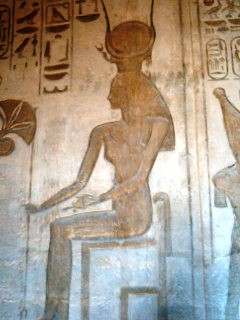
Goddess Hathor.Abu Simble Temple,1200 B.C.


King Narmer tablet" a cast carved by Yasser Kamel,black marble.

The true significance of Hathor in the Egyptian creed and myth. A

Hathor the cow-goddess is among the oldest gods in the Egyptian pantheon. Hathor also was one of the most popular goddesses there as she played the role of the holy mother and the wife for many of the ancient triads of deities. Hathor also was the perfect force that "Ra" had required in order to maintain balance between his flaming heat" skhmet" the urging power of the heat and the gentle force of appeasing "Hathor". Indeed the Egyptian myth describes both of the goddesses Hathor and Sekhmet to be the Yen and Yang. Goddess Hathor had to carry" Ra" the sun god out of the "Nun" the water as he sunk into it in order to appease its energy once he established the basic creation. Hathor the Egyptian Yen-force also had signified for the welfare, the prosperity, the wealth, the harmony and the unity. We can observe that powerful meaning in Predynastic and the archaic tablets that describe the unification trials in ancient Egypt and specifically the one belongs to king's Narmer 3200 B.C.
Starting from the Old-kingdom, 2878 B.C Hathor had become to represent the love, the joy and the maternity. Further on, Hathor was seen representing mainly the joy, the fun, the drunkenness and the fertility. The Bible and the Quraan brought us a very similar historical tale about an ancient Egyptian king and Joseph the prophet and it mentions the king in Egypt to suffer form a successive scary visions and he panicked then asked for counseling the dream-interpreters he had and none of them could help then they released Joseph from his prison and had been able to advise the king of Egypt. The king in his dream could see seven lean cows fierce and eat seven fat cows. According to Joseph's interpretation "Egypt should expect seven years of drought and dearth where the Nile would never flood" So the Hathors will be eaten and there will be no prosperity or welfare. Copyrig ©Musegypt. 2006

Art in ancient Egypt ! My T.V talk today! I hope you find it enjoyable!💙💙💙

Art in ancient Egypt ! My T.V talk today! I hope you find it enjoyable!