Friday, May 29, 2015


Thursday, May 07, 2015
The pyramids of Giza site

The
pyramids of Giza site is a major attraction to millions of travelers ,
but in order to have an enjoyable and an informative visit , the
tourist should by escorted/ accompanied by a licensed tour
guide/Egyptologist rather than led by the Giza site released vendors ,
having such qualified tour guide would make your whole journey much more
convenient ! Yasser kamel
Visit the tour guides directory to find the best tour guides or contact Museumegypt !
http://tourguidesdirectory.blogspot.com/
Visit the tour guides directory to find the best tour guides or contact Museumegypt !
http://tourguidesdirectory.blogspot.com/
Tuesday, February 17, 2015
The victory inscription of Weni

The victory inscription of Weni
A poetic inscription belongs to the high official Weni
about 2300 B.C describes the victory of the Egyptian army over the desert
nations , Weni served under several kings such asTeti, Merenra and Pepi.
-
This army came back in peace after,
he(it) destroyed the land of the sand dwellers
-
This army came back in peace ,after
he (it) demolished its forts
-
This army came back in peace ,after
he (it) crushed the land of the sand dwellers
-
This army came back in peace , after
he (it) demolished its forts
-
This army came back in peace ,
after he (it) cut down its figs and its vines
-
This army came back in peace ,
after he (it) set fire in the properties
of all its chiefs
-
This army came back in peace, after he (it) slaughtered the troops in it ,in many
tens of thousands
-
This army came back in peace, after
he (it) brought from it the troops in
very great ( number ) of captives , his majesty praised me for it more than any
thing.
-
ii.n msha
pn m htp
-
This army came back in peace
-
khba.n.f ta hryw sha
-
after he(it) destroyed the land
of the sand dwellers
-
ii.n msha
pn m htp
-
This army came back in peace
-
Psdj.n.f ta hryw sha
-
after he (it) crushed the land
of the sand dwellers
-
ii.n msha
pn m htp
-
This army came back in peace
-
seshn .n.f wnwt f
-
after he (it) demolished its
forts
-
ii.n msha
pn m htp
-
This army came back in peace
-
Sha .n.f djbaw f iarrt f
-
after he (it) cut down its figs
and its vines
-
ii.n msha
pn m htp
-
This army came back in peace
-
Sti .n.f kht m qrgw f nb
-
after he (it) set fire in the properties of all
its chiefs
-
ii.n msha
pn m htp
-
This army came back in peace
-
sma.n.f tswt im f djbaw ashaw
-
after he (it) slaughtered the troops in it ,in many
tens of thousands
-
ii.n msha
pn m htp
-
This army came back in peace
-
in.n.f tswt im f ashat wrt m
sqrw ankhw hsi wi hm.f hr s r kht nb
-
after he (it) brought from
it the troops in very great ( number )
of captives , his majesty praised me for it more than any thing.
Monday, July 07, 2014
Museumegypt now is eight years old !

Museumegypt now is eight years old ! Thank you for following us!
Yasser kamel
Thursday, April 17, 2014
Walls and floors in ancient-D

The unsolved mystery of the interlocking stones has never ceased to amaze all minds , the
amount of difficulty to comprehend its techniques and the precision of its
position should indicate the superiority of the ancient Egyptian civilization
!.
The V-shape interlocking
stone which is frequently used in the old kingdom temples such as the one of
king Chephren at Giza is among the most complicated types . Such V-block which
is more than a meter thick and weighs
several tons has a distinctive function as a connective stone for the temples
walls and corners (F-2).

F-2
The majority of the
interlocked stones are cubical and tightly located with no space left between
which never required any mortar to fix . Such method was invented by the
ancient Egyptian architects to secure the temples against earth-quakes ,
massive floods and tsunami waves. The most astonishing fact about such interlocking
is that the used blocks are unequal in size and different in posing ! Most of
them located in leaning pose or no right angel one to pressure the next stone
in order to prevent any attempt to remove or relocate (F-3).

F-3
Written by Yasser kamel for
Museumegypt.2006@.All rights reserved.
Tuesday, February 25, 2014
Monday, October 21, 2013
The phenomenal sun shine at Abu Simbel

Tomorrow
"22-October" will have the significant event of the phenomenal sun
shine on Ramses II face at Abu Simbel new location" chosen by the UNESCO
to rescue it in year 1964" where it shines precisely on his statue in
the center of the temple's holy of
hollies room! . The mentioned date is one of the two dates for such
phenomena to occur! Painting and words by Yasser kamel .Read more on my
blog http://museumegypt.blogspot.com/2013/10/the-magnificent-scale-of-abu-simble.html
Sunday, October 06, 2013
The magnificent scale of Abu Simbel.

The Great temple
of Abu simbel"
damage minimized" 2013 Painted by Yasser Kamel.
The
overwhelming impression that Abu Simbel cause once to be viewed has no match ,
just a single glimpse on its stunning façade which exceeds 40.M high and
spotting the four colossal statutes of the great Ramses which are about 20.M
high is a mind boggling moment! Such remote and complete temple that goes back
to 1200 B.C and left with intact colours for the interior and minimal damage
for the exterior ,then its engineering based astronomy which allowed its
architects to align the statue of Ramses II in its innermost room to the sun
rise on two certain and special days for the king. One of the days is supposed
to be his birthday and the other is supposed to be his coronation day! Originally the dates were the 21st
of February and the 21st of October which were missed by UNECCO saving project
of Abu Simbel between the years 1964-1968 and the phenomenal sun shine on
Ramses II face became a day forward for each date. However the great efforts
exerted by the rescue team to make a perfect a transfer and reconstruction into
a safe spot from the growing man-made lake Naser with a cost exceeded 50
million USD, it failed to re-angle the great Abu Simbel in the right position to
keep its aligning with sun accomplished ! The other great challenge and obstacle
from an artistic and architectural perspective, is to reveal the method that
possibly followed by the artist in order to stereotype such four identical and
gigantic statues of the pharaoh .

Abu-Simbel-Francois-Gau-1819
The
possible scope that the artist could have on the narrow Nile bank for Abu
Simbel would be too much vertical in
vision than it is required to make a
good judge on the statues proportions which make his task rather impossible.

An imaginary stone
print created by a metal stencil. Painted and designed by Yasser Kamel.
The scope of the giant Abu Simbel which naked eyes never can
comprehend or realize would force the artist to count on different tools,
implements and methods to help him to carry out his plan. The ancient Egyptians
were familiar with moulds and stencils methods which enabled to create such
stereotyped carvings and specifically the repetitive Hieroglyphic characters. Ideally two
dimensional-metal stencils are suggested for the use in order to accomplish
accuracy and the identicalness. Based on my
experience of sketching a part of the Great Abu Simbel on very small scale I believe
that such enormous statues would never become identical without following such
method!. Written and painted by Yasser kamel for
Museumegypt.2006@.All rights reserved.
Monday, September 16, 2013
Seth , the invincible force !
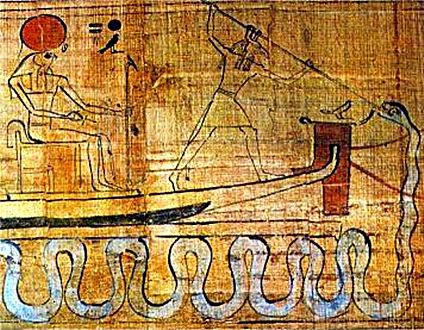
Seth , the invincible force !
Seth is counted evil in common referring to the ancient myth of Osiris, Osiris the heir of Ra and his legal descendant and the good brother for Seth. Osiris death by Seth would not be evadable; his body portions had to be spread around Egypt then to be reassembled by his wife and sister Isis which referred to the unification of Egypt. The ancient Egyptians due to such creed considered Osiris to be the fertility causer and gave him different colours to emphasize his fertility such the blue which indicates the Nile fertility and it’s indigo which was brought by it’s inundation floods or the green to indicate Osiris force that effected vegetation . Seth on the other hand had been sentenced for ostracism and the exile .So due to that destiny Seth’s realm had turned to the wasted lands, the arid and the barren lands as well as the salty water. Looking at the deep meaning behind such isolation for Seth make us more familiar of Seth’s incredible power which Ra had privileged him with , the force that can reclaim arid desert to vegetation ,the force that can desalinate the sea and the force which can hunt and tame the evil. The papyrus scene shows the use of Seth’s force to tame or hunt down the coiled snake of evil. In such notion Ra and Seth refer to the Yen and yang or the positive and the negative forces so there no wonder to find some mighty pharaohs such Seti I to be named and related to the invincible force of Seth. Written by Yasser kamel for Museumegypt.2006@.All rights reserved.
Tuesday, August 06, 2013

Famous Prince Abbas cruise-ship in lake Nasser

Famous Prince Abbas cruise-ship in lake Nasser.
Sailing in lake Nasser is the most enjoyable way to visit the Egyptian temples in the Egyptian desert which was named by early explorers as the Nubian Desert! The visits include sites such as the Kalabsha temple, Bait el waly temple, Wadi El Seboa, the Derr site and the great Abu Simble temples and their famous approach from the lake side.
Yasser kamel
Monday, July 15, 2013
Walls and Floors in ancient Egypt-C

The Pyramids of Giza represent a different
type of stone interlocking which is
based on a tenon and mortise method.

Tenon and Mortise method.
F-1.
The method of the Tenon
and Mortise was used to attach the outer limestone blocks of the pyramids
“F-2”.
F-2 shows the deeper stone
blocks while the stone tenons being kept.

F-2
Written by Yasser kamel for Museumegypt.2006 .All rights reserved.
Tuesday, July 09, 2013

Saturday, May 18, 2013
The Art of the Egyptian Papyri."Part-3"

The Art of the Egyptian Papyri
Within the New Kingdom
period, 1500- 1100 B.C, the funeral papyri “Book of the dead” became widely
spread around the whole country and also it became affordable to others than
royals. The popularity and the spread for that type of papyrus books had
synchronized with a simplicity trend for the accompanying art of those papyri.
The use of the classical drawings in book of
the dead, in ancient Egypt, did require a highly skilled artist as well as much
of time which had a negative effect on papyrus cost while the use of the
simplified art on papyrus which requires less skilled artist and takes less
time to finish was a help to allow major number of people to get it. The
Egyptian artist used the stroke-order style or the simplified for the repeated
and exact god’s figures which used to be made in classical style before. The figures above show the simplified style for a man and the
possible strokes led to have them drawn. Another example of such stroke-order
use is for the funeral papyrus of khonu
,the 18th dynasty where the stroke –order rule is applied –F-1
The following stages are the possible ones to create such stereotype
images on Khunso Papyrus.

Stage-1 it simply done by drawing the human head and the head
dress.

Stage-2. is done by drawing a straight line which ends with a
human hand.

Stage-3. drawing the disc

Stage-4. drawing a slash to represent the torso and the left
leg.

Stage-5. is where to draw what looks almost like a straight
line which refers to the back and the right leg for the human figure.
Written and painted by Yasser Kamel for
www.museumegypt.blogspot.c
Friday, May 17, 2013
Just finished two informative and detailed full days of visits where I took the students of the University of Arkansas accompanied by Jerome Carl Rose ,Professor of Anthropology

Yasser kamel
Tour guide and Egyptologist
17-May-2013
Tuesday, April 09, 2013
Ancient Egyptian Fine Art

Thursday, March 14, 2013
Egyptonews

Egyptonews
A new discovery in Luxor
by an Egyptian and German archaeological
team. The team succeeded to uncover 14
granite statues, 2 m high, that represent the Egyptian lioness goddess of war, devastation
,havoc and wrath , Sekhmet . The finds
came from the ruins of the funeral temple
of
Amunhotep III(
1400 B.C) at the west bank.
Friday, January 18, 2013
Pictures and Comments

Photo by Niki Whitehouse
Karnak temple. A wall carving shows the two cartouches of king Seti II who was the son of King Mernptah and the grandson of Ramses II(The great)in about 1200 B.C. It seams that he was not powerful enough as he failed to protect Upper Egypt from his rival and half brother Amunmes who managed to rule Upper Egypt for a short while until Seti II succeeded to return it to his control.
The famous cartouche (from the left, King of Upper and Lower Egypt, first cartouche( User-Khebrow –Ra, Mer-Amun) which means “the mighty existence of Ra and the beloved of Amun) the second cartouche or the famous (Seti-Mer -Ptah ) which means “ The one of Seth and the beloved of Ptah).Written by Yasser Kamel for Museumegypt,Copyright@museumegypt. All rights reserved.
Tuesday, December 18, 2012


Monday, November 19, 2012
Picture and Comment

Photo by Niki Whitehouse
Edfu Temple. A column has the coronation cartouche of Ptolemy XII,Euletes( Neos Dionysos) the Drunkard who was father of Cleopatra VII (the famous one). He was exiled by his elder daughter Ber
enice
IV then managed to rule again. The upper register of hieroglyphics
starts (from left side ) with the Osiried king, gods ,king of Upper and
lower Egypt ,Kings Cartouche, beloved of Horus of Behdet (Horus of
Edfu).
The lower register has the Cartouche in the center while the falcon –headed sphinx which is a form of god Horus from the left and the vulture goddess Nakhbet from the right. The text above the sphinx head reads Horus of Behdet(Edfu) and the one above the vulture translates to the drunkard king. Macedonian period 55.B.C. Written by Yasser Kamel for Museumegypt,Copyright@museumegypt. All rights reserved.
The lower register has the Cartouche in the center while the falcon –headed sphinx which is a form of god Horus from the left and the vulture goddess Nakhbet from the right. The text above the sphinx head reads Horus of Behdet(Edfu) and the one above the vulture translates to the drunkard king. Macedonian period 55.B.C. Written by Yasser Kamel for Museumegypt,Copyright@museumegypt. All rights reserved.
Subscribe to:
Posts (Atom)
Art in ancient Egypt ! My T.V talk today! I hope you find it enjoyable!💙💙💙
Art in ancient Egypt ! My T.V talk today! I hope you find it enjoyable!

-
 The most incredible evidence of how much the Heb-Sed was essential to stabilize Egyptian powerful kings on their throne is represented o...
 -
Art in ancient Egypt ! My T.V talk today! I hope you find it enjoyable!
-
 象形文字 で 蜂 の 名前 は ビイチイ でした。古代 イジプト の 神話 に 蜂 は 太陽 神 様 の とも ですくて、蜂 も 蓮 と 朝顔 を 匂う、蜂 は 象形文字 で ごい は 王 です。それから、蓮 の 匂うこと は うまれかわり が 印 を しました。古代 イジプト ...

